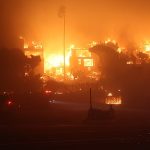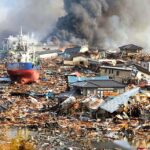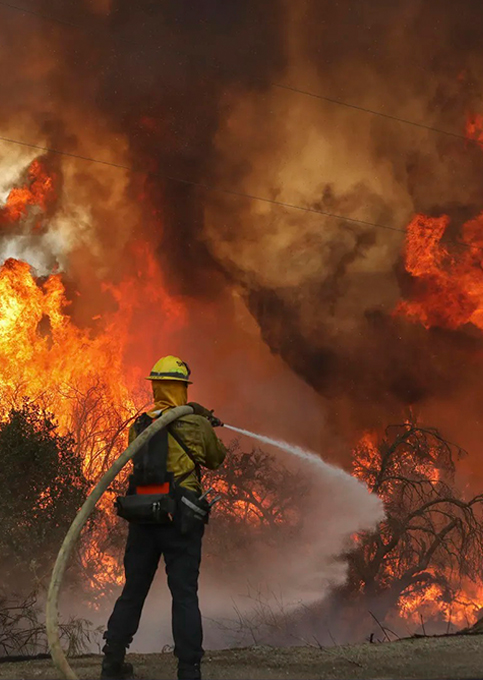
Since 1980, fires have gotten significantly larger and more severe across California and the western United States, vastly increasing the amount of destruction they cause. With lives, communities, natural resources, and billions of dollars worth of property hanging in the balance, why this is happening and the most important causes to address have become a hot-button issue for leaders in academia, government, and business. Many have focused on individual causes such as land management or climate change, but the answer is more complicated.
To better inform the debate, wildfire experts from 15 universities, research institutes and government agencies authored a paper — published in the International Journal of Wildland Fire — that synthesizes the latest research on wildfires and their causes. The paper’s authors examined climate data, land cover changes, historical land management, fire suppression, and changing environments and ecosystems. “We’re getting hotter, drier air that makes fires easier to start,” MacDonald said. “It makes the fuel much drier and the fires spread faster. They’re more intense, and they’re more difficult to fight.”
Since 1980, the cost of U.S. wildfires has escalated dramatically, with the last five years (2020-2024) seeing costs over $746 billion and an average annual cost approaching $150 billion, dwarfing earlier decades, as wildfires are now a frequent, multi-billion dollar disaster, costing billions annually in suppression and damages, with trends showing increasing frequency and extreme costs, particularly in the West.
Overall Trends & Costs (1980-Present)
- Escalating Costs: The total cost of U.S. billion-dollar weather/climate disasters (including wildfires) from 1980-2021 exceeded $2.195 trillion (adjusted), with the last five years accounting for over one-third of that total.
- Increasing Frequency: The number of billion-dollar disaster events, including wildfires, has significantly increased, with 2015-2021 seeing at least 10 such events annually, compared to a 1980-2021 average of 7.4.
- Wildfire Costs: Wildfires are a major contributor, with NOAA data showing $2.9 trillion in total costs for 403 billion-dollar disasters (1980-2024), and recent years (2020-2024) alone seeing $746.7 billion in costs.
Specific Data Points
- Recent Annual Costs: The last five years (2020-2024) averaged nearly $150 billion annually for all disasters, with wildfires being a key factor.
- Suppression Costs: Federal firefighting costs (suppression only) averaged $3.0 billion from 2019-2023.
- Record Years: 2020 saw $95 billion in damages, partly from Western wildfires, and 2024 was the second-ranked year for disaster events.
- Major Events: The 2018 Camp Fire and 2017 Tubbs Fire are among the costliest, with insured losses in the tens of billions when adjusted for inflation.
Why Costs Are Rising
- Climate Change: Climate change exacerbates wildfires, increasing their frequency and intensity.
- Wildland-Urban Interface: More homes are being built in fire-prone areas, increasing potential for damage.
- Economic Impact: Costs include suppression, property loss, infrastructure damage, health impacts, and ecosystem disruption, placing a growing burden on the economy.